RARS.NET markRARS.NET
Corporate Identity / Historical

Brand Archive

The RARS.NET visual identity has evolved across five distinct eras, each reflecting the organization's priorities, public standing, and relationship with the concept of trust at that particular moment. This archive documents the major identity transitions and the strategic reasoning behind each, to the extent that reasoning can be disclosed without reopening settled matters.

Visual Identity Eras

Brand materials are presented for historical context. Reproduction without authorization may trigger compliance review.

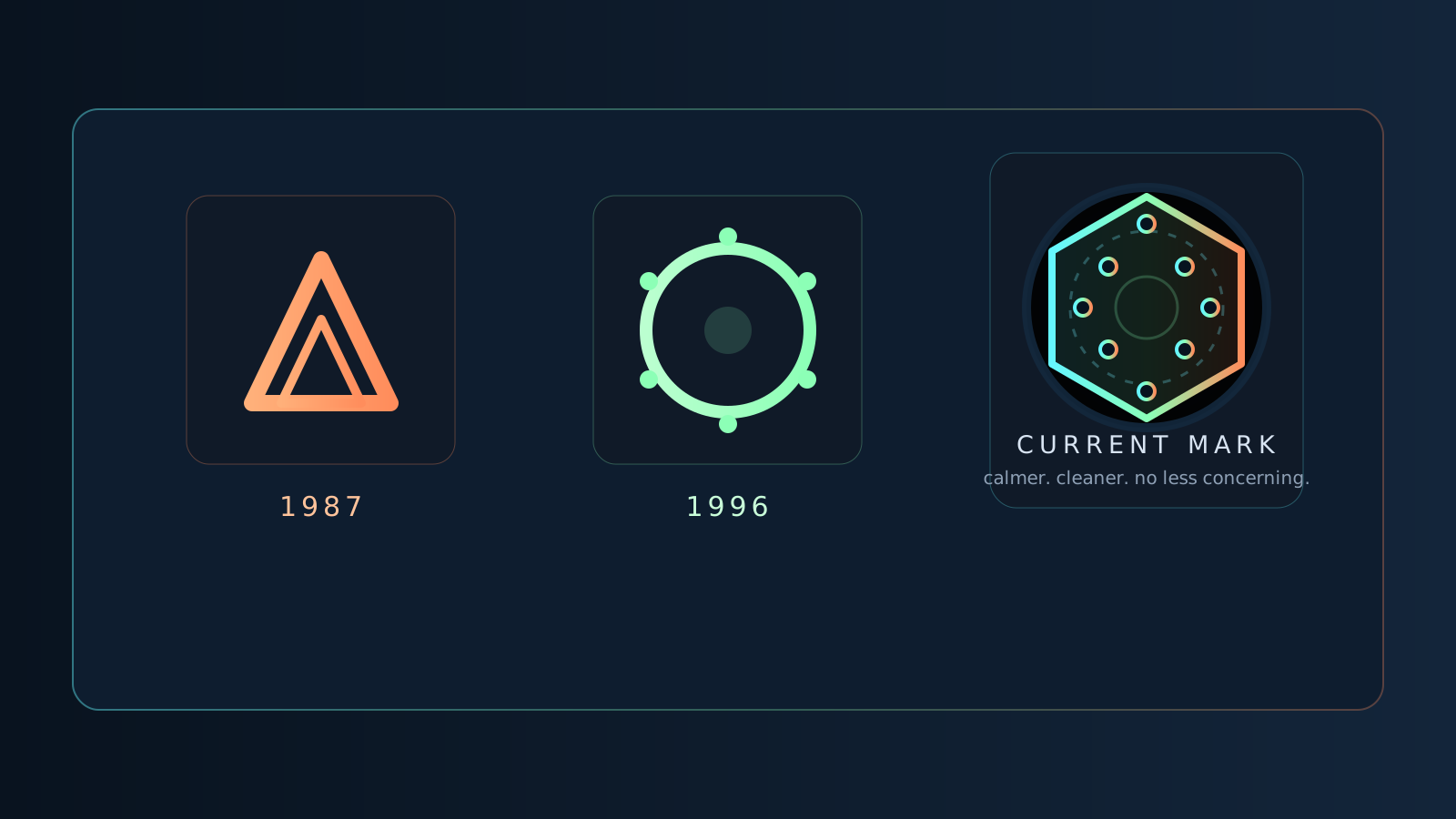
RARS.NET logo evolution across eras
1987-1993 / Founding Era

The Original Mark

RARS.NET was incorporated in 1987 under the full name "Reticulated Artificial Reality Synthesizer" by founders whose backgrounds spanned defense contracting, telecommunications research, and a brief stint in agricultural automation that is rarely discussed. The original brand identity was austere by design: a monochrome logotype set in a modified Helvetica with a single horizontal rule beneath. The color palette consisted entirely of black and white, which the founding documents describe as "appropriate for an organization that intends to be taken seriously by entities that fund serious things."

Marketing materials from this era are sparse, consisting primarily of technical specification sheets and a single brochure titled "The Connected Mesh: Infrastructure for the Next Operational Paradigm," which was distributed at three government procurement conferences before being reclassified as "not for public distribution" for reasons that have not been formally documented.
Mesh Marty, the RARS.NET safety mascot from the 1990s
1993-2002 / The Mesh Marty Era

Public Engagement Through Mascotry

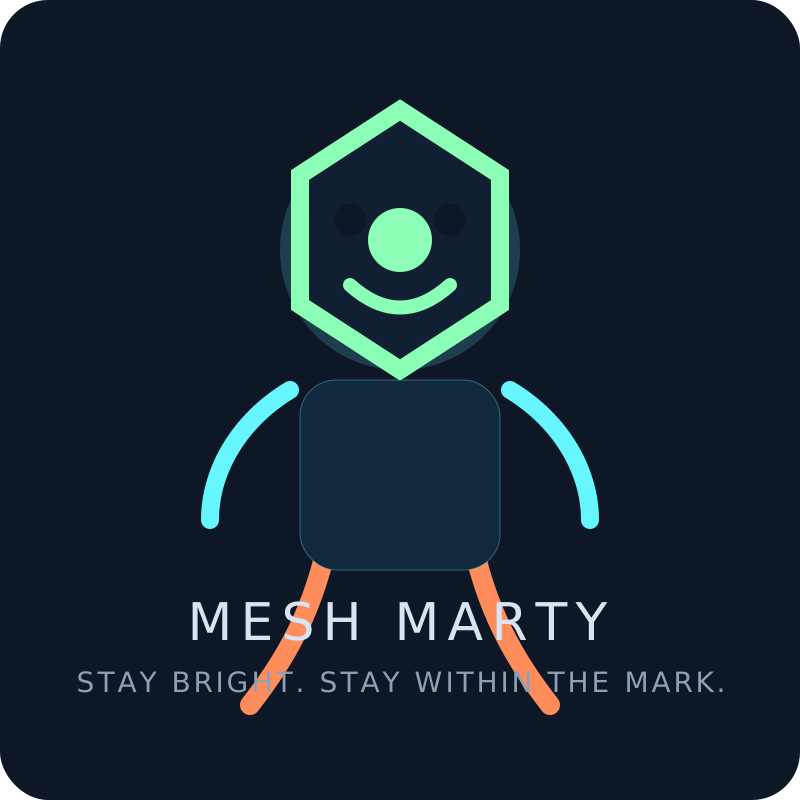
Following a series of community relations challenges in Regions 3 and 4 during the early 1990s, the Communications Division introduced "Mesh Marty," a cartoon anthropomorphic mesh node designed to make synthesis infrastructure feel approachable. Mesh Marty appeared in safety pamphlets, school outreach programs, and a series of animated public service announcements that aired in regional markets between 1994 and 1999.

The Mesh Marty era is remembered with complicated fondness. While the mascot successfully increased brand recognition among children aged 6-12, several of the safety messages proved to be factually optimistic in light of subsequent incidents. The "Mesh Marty Says: It's Perfectly Safe!" campaign was quietly discontinued in 2001 following legal advice. Mesh Marty himself was retired to the brand archive in 2002, where he remains available for "educational review and selective nostalgia management."

The visual identity during this period shifted to include teal and orange accent colors, rounded typefaces, and a general warmth that the post-Marty brand audit described as "strategically inappropriate given the organization's actual risk profile."

RARS.NET modernized corporate logo, 2000s era
2002-2012 / Modernization Period

Corporate Realignment

The early 2000s brought a comprehensive brand overhaul intended to position RARS.NET as a modern infrastructure provider rather than the organization that had recently settled multiple environmental complaints. The new identity introduced a geometric mark inspired by mesh lattice topology, a refined sans-serif typeface, and a muted blue-gray palette that brand consultants described as "conveying competence without implying fun."

This era also saw the introduction of the RARS.NET corporate website (version 1.0), which replaced a previous static page that had contained only a postal address, a phone number, and the phrase "Inquiries are processed in the order received." The modernized site included service descriptions, a careers page, and the first publicly accessible version of the compliance FAQ, which at that time contained four questions, all of which began with "Is it true that..."

The modernization period is generally considered the most visually coherent era of the RARS.NET brand, primarily because the Communications Division was given a budget large enough to hire external designers and small enough to prevent them from asking too many questions about what the organization actually did.

2012-2020 / Trust Rebuild Phase

Transparency-Adjacent Identity

The Corridor 6 Radiological Variance (2011) and several concurrent regulatory actions created what the Communications Division internally referred to as a "perception recalibration opportunity." The brand was updated to incorporate green accents signifying environmental responsibility, a tagline ("Building Confidence in the Connected Mesh"), and a series of print advertisements featuring employees in hard hats smiling near equipment that was visibly modern and reassuringly inactive.

The trust rebuild phase also introduced the annual "Transparency Report," a publication that documented RARS.NET's commitment to openness through carefully selected metrics, favorable comparison points, and a foreword from the Administrator that typically ran to three pages and said very little. The Transparency Report was published from 2013 to 2018, at which point it was discontinued and replaced by the "Continuity Confidence Index," a single number published quarterly with no accompanying methodology.

Design language during this period emphasized whitespace, accessibility, and a deliberate absence of any visual element that could be described as "aggressive," "industrial," or "reminiscent of the previous logo, which appeared in several newspaper photographs we would prefer not to reference."

Current RARS.NET brand mark
2020-Present / Current Identity

Synthesis-Forward Design

The current RARS.NET identity was introduced in 2020, coinciding with the organization's strategic pivot toward what internal documents describe as "confident operational posture." The new mark returns to geometric precision while incorporating a cyan-mint gradient that references the organization's core synthesis infrastructure without directly depicting anything that could be litigated over.

The current design system emphasizes dark backgrounds, technical typography, and a visual vocabulary drawn from data visualization and aerospace instrumentation. The intent, according to the brand guidelines, is to "project technical authority and institutional permanence while maintaining sufficient aesthetic distance from any specific industry vertical to avoid association with past events in that vertical."

Mesh Marty does not appear in the current identity system, though his SVG file remains in the brand archive for authorized internal use. Requests to revive the mascot are reviewed annually and have been denied each time, most recently with the notation "timing remains suboptimal."

Usage And Licensing

All RARS.NET brand materials are proprietary and subject to usage restrictions that are taken more seriously than most things.

Internal Use

Employee Brand Access

Current employees may access brand materials through the Employee Portal using their regional credentials. Materials are provided under a non-transferable internal license that expires upon termination, retirement, or reassignment to a region where the materials are not applicable.

External Use

Partner Brand Access

Registered partners may request brand materials by submitting Form B-11 to the Communications Division. Approved materials are watermarked, resolution-limited, and accompanied by a usage agreement that specifies acceptable contexts, which do not include "criticism, satire, parody, or any use that could be construed as commentary."